Confidence grows when children make things that work
Project-based learning helps children see real results, treat mistakes as information, and take ownership. Here is how parents and schools can use it.
Introduction
Every parent has seen it: a child who says "I can't do this" before even trying. Confidence is not something we can hand to a child with praise alone. It grows when children try something hard, struggle, and succeed on their own terms. Project-based learning (PBL) is one of the most effective ways to create those moments. This post explains what PBL is, why it builds confidence, and how families and schools can use it, with robotics and coding as examples.
What is project-based learning?
In project-based learning, students learn by working on a real problem or product over a period of time, instead of only listening to lessons and answering questions. A project has a goal, a process, and an outcome that can be shown to others.
Compare two ways of learning about sensors:
The second approach still covers the concepts, but it adds purpose, ownership, and the satisfaction of creating something.
- Traditional: read a chapter, memorise definitions, answer questions.
- Project-based: build a device that turns on a fan when the room gets warm, and learn about sensors by making it work.
Why PBL builds confidence
Educational research on active and experiential learning broadly supports the idea that students who actively create things tend to be more engaged. Without quoting specific numbers, here is why the approach tends to build confidence in practice.
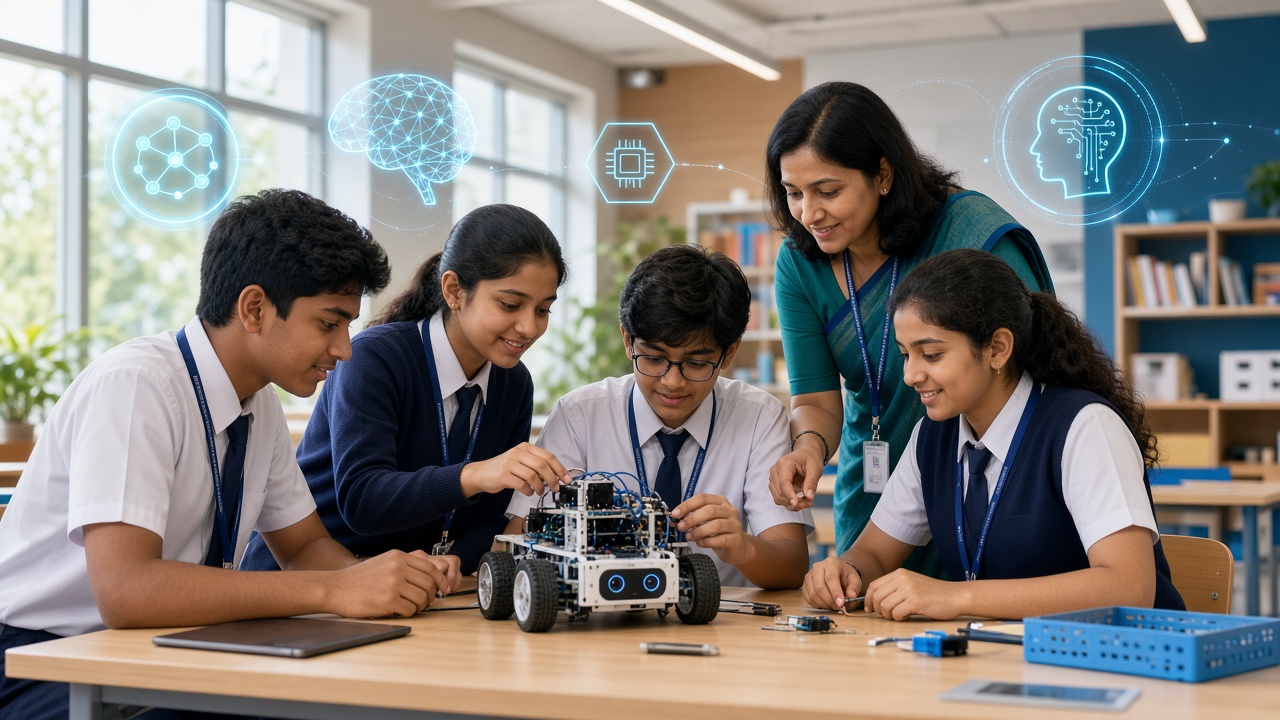
1. Children see real results. A working robot is proof of ability. It is much harder to feel "I'm bad at this" when you are holding something you built.
2. Failure becomes normal. In a project, things break. A sensor reads wrongly, the code has a typo, a wheel falls off. Children learn that mistakes are information, not verdicts on their intelligence. This is sometimes called a growth mindset: the belief that ability develops through effort and learning.
3. They own the decisions. When students choose how to solve a problem, they take responsibility for the result. That sense of ownership is a strong motivator and gives them pride in their work.
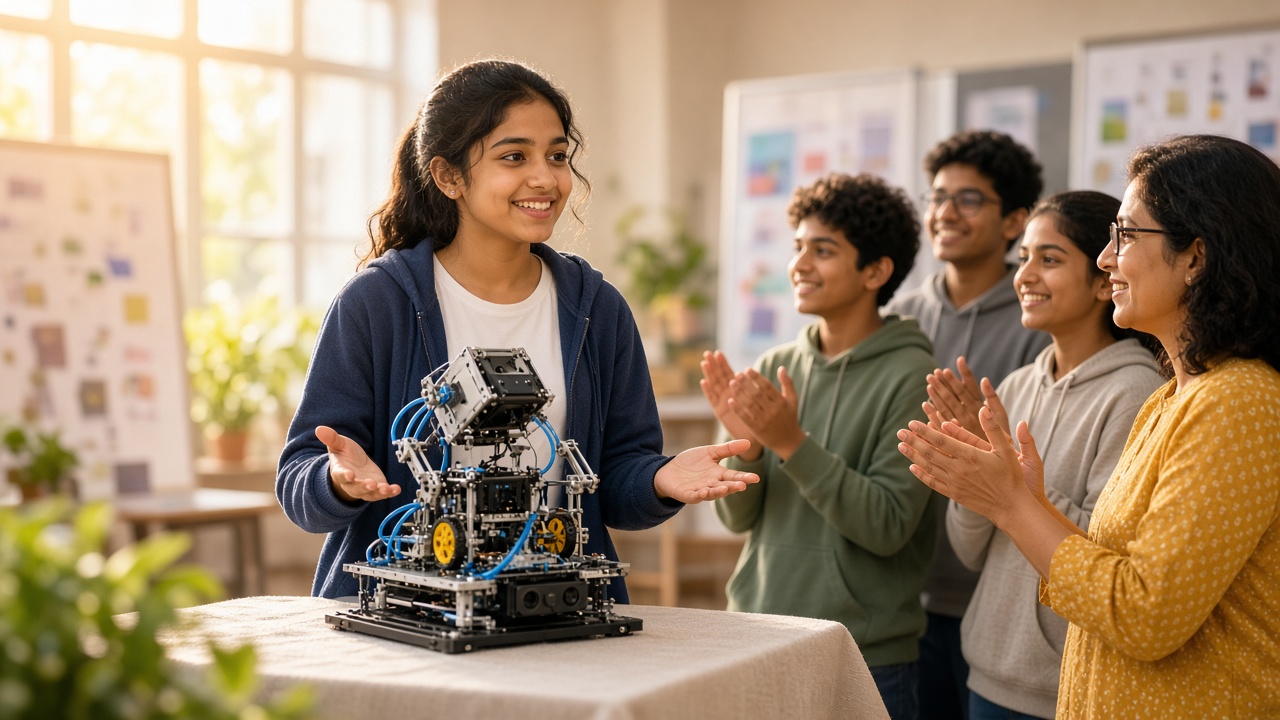
4. Skills are practised, not just known. Presenting, explaining, planning, and cooperating are skills that need practice. Projects create natural opportunities, such as explaining a design to a classmate or demonstrating it to parents.
5. Small wins add up. Good projects are broken into stages: plan, build, test, improve, present. Each stage ends with a small win, and these steadily build belief in one's own ability.
A robotics example, step by step
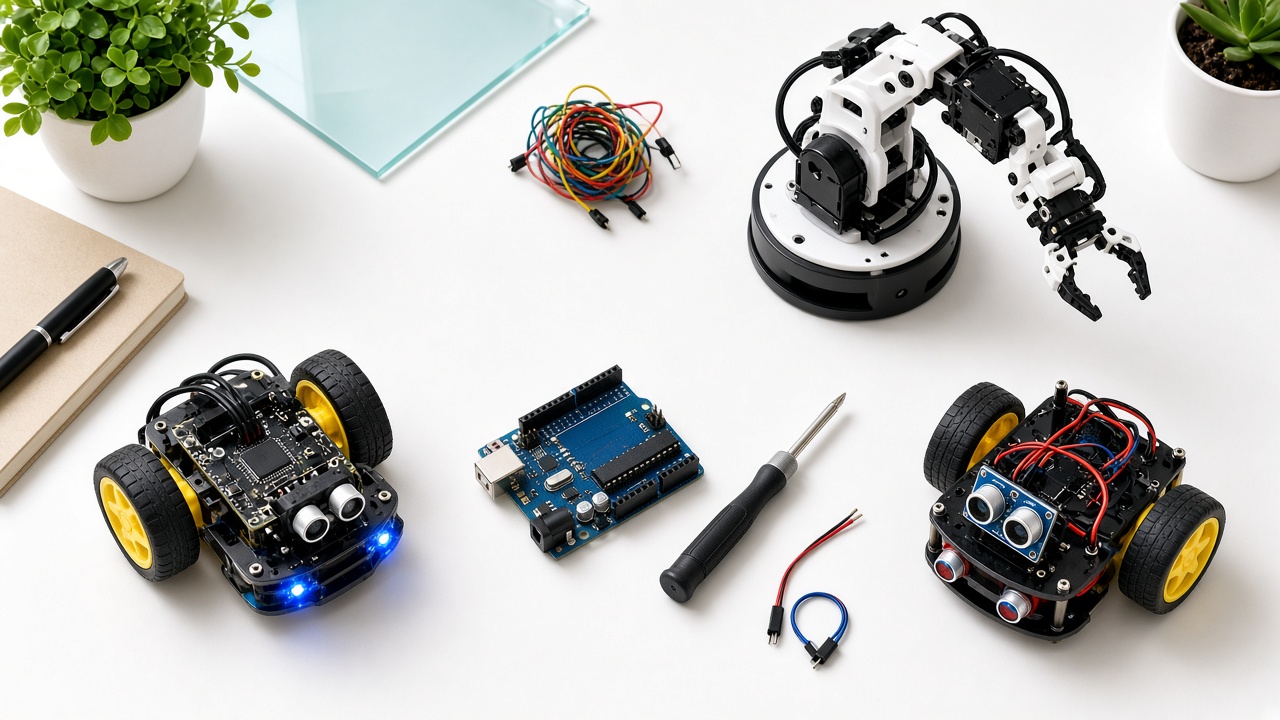
Take a simple challenge: "Build a robot that follows a line.".
1. Understand the problem. What should the robot do? How will we know it works? 2. Plan. Sketch the robot, list the parts, and agree on roles. 3. Build. Assemble the chassis, connect sensors, and write a first program. 4. Test and fail. The robot drifts off the track. Why? 5. Improve. Adjust sensor positions or change the code. 6. Share. Run the robot in front of the class and explain how it works.
At every step, the child is thinking, deciding, and learning from feedback. At the end, they can say, "I made this.".
What good PBL looks like
Not every "project" delivers these benefits. A strong project usually includes:
Be cautious of projects that are really step-by-step copy exercises with no room for decisions.
- A meaningful question or problem, ideally connected to the child's world
- Student choice over some part of the design or approach
- Time for iteration, so students can improve their first attempt
- Support from mentors who guide with questions rather than giving answers
- A public outcome, such as a demo, exhibit, or presentation
- Reflection, where students think about what they learned and what they would change
How parents and schools can support PBL
How parents can support PBL at home. Ask curious questions. "What are you trying to build? What happened when you tested it?"; Resist fixing it for them. Let your child struggle productively for a while; Praise process, not only results. "I liked how you kept trying different ideas."; Provide a space. A small corner for materials and works in progress helps; Attend the demo. Being an audience matters more than most parents realise.
How schools can use PBL. 1. Connect subjects. A single project can bring together science, maths, language, and art, which is the idea behind STEM integration. 2. Use clubs. An Innovation Club gives interested students a regular space to work on self-chosen projects. 3. Set up a lab or maker corner. Hands-on resources make projects practical. 4. Assess more than the final product. Look at planning, teamwork, problem-solving, and reflection. 5. Hold showcases. Exhibitions and demo days give students a real audience.
Common challenges, and whether PBL replaces regular studies
Common challenges and solutions. Time pressure from the syllabus. Start with one short project per term and link it to existing topics; Uneven teamwork. Assign clear roles and rotate them; Teacher confidence. Provide training and ready-made project guides; Fear of "wrong" answers. Make a habit of celebrating good mistakes and what they taught.
Does PBL replace regular studies. No. Students still need core knowledge and practice. PBL works best as a complement that makes concepts meaningful and memorable. Many students find that applying a concept in a project helps them understand it more deeply when they return to textbook problems.
Frequently asked questions
Q: At what age can children start project-based learning? A: From early primary years, with age-appropriate projects. Younger children may build with blocks or make simple circuits, while older students can design robots, apps, or science investigations.
Q: What if my child gets frustrated and wants to quit? A: Frustration is a normal part of the process. Help your child break the problem into a smaller step, take a short break, and then try again. Celebrate the smallest progress to rebuild momentum.
Q: Will PBL help with exam performance? A: It can support understanding, curiosity, and study habits, but results vary by child and context, and we cannot promise specific marks. It is best seen as a way to strengthen learning, not a shortcut.
Learn by building with SheepByte
SheepByte is an AI and robotics education company based in Udaipur, Rajasthan. Our Robotics Lab, Innovation Club, Coding Bootcamp, AI Learning, Drone Technology, and STEM Integration programs are built around hands-on projects that help students create, test, improve, and present their ideas. We run workshops in Jaipur, Delhi, and online.
To get started, write to support@sheepbyte.com or visit sheepbyte.com.